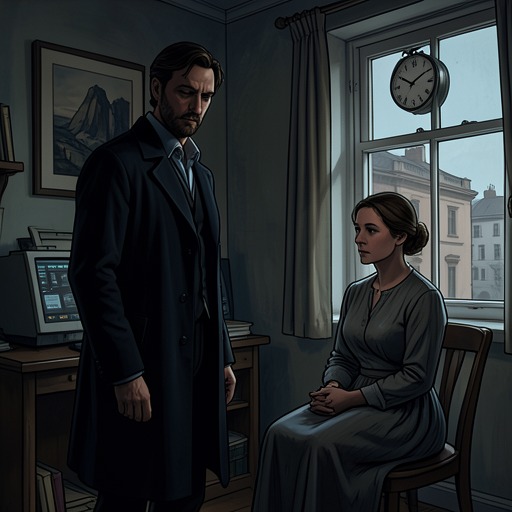
Addiction as self-deception
Beautiful Boy: A Father's Journey Through His Son's AddictionAddiction as self-deception is presented as more than concealment from other people: it is a corruption of the addict’s own judgment, in which the mind supplies convincing reasons to resume using and to dismiss the need for recovery. Through Nic Sheff’s relapses and David Sheff’s attempts to understand them, the book traces how this private distortion becomes a family crisis, sustained by lies, guilt, and silence but also challenged by treatment, mutual support, and public testimony.
The addict’s unreliable reasoning
Nic explains to David that an addict using drugs cannot trust his own brain. It offers apparently limited exceptions—one drink, one joint, a single line—then expands the permission: the addict has outgrown his sponsor, no longer needs the vigilant program that helped him emerge from relapse, and is happier and more independent without it. The sequence makes self-deception an active argument rather than a simple failure to remember the risks. Each claim recasts danger as freedom and dependence on recovery as unnecessary. Nic’s account also identifies the counterweight: reliance on Randy, meetings, the program, and prayer when his own reasoning becomes unreliable.
David recognizes that pattern when Nic claims a relapse was a brief, three-day mistake and insists that he is fine. As the call continues, David hears what he identifies as Nic’s voice under the influence. He can anticipate the approaching disaster and warns Nic not to follow the logic of his brain while it is affected. The painful contrast is between what the family already knows and what Nic’s account permits him to acknowledge: the warning is clear, but knowledge alone cannot make him accept it.
The deception also reaches beyond a user’s assurances about being well. When Nic says he and Z. are returning from Joshua Tree and have just regained cell-phone service, David recognizes that this is a carefully extended lie. Nic could have given a minimal update, but instead adds detail to make the original falsehood harder to question. David connects the episode to the familiar pattern of addicts lying and even helping others search for what they have stolen. The lie is intricate enough to resemble confidence, yet its construction exposes how thoroughly trust has been compromised: David listens more than once because he wants to remember the message and the knowledge that made its falsehood legible.
Secrecy, shame, and the family
Self-deception is not confined to the person using drugs. For a long time David keeps the family’s problem private, explaining that he wants to protect Nic’s good reputation rather than that he feels ashamed. The secrecy nevertheless isolates the family and makes it harder to speak plainly about the addiction. David comes to recognize the force of the recovery-group saying that a person is as sick as their secrets: talking about Nic’s addiction, reflecting on it, and hearing other people’s accounts offer a kind of help that silence had withheld.
At an Al-Anon meeting in Novato, David and Karen Barbour sit with about a dozen people in plastic chairs arranged in a circle. David first feels condescension toward the other attendees, then leaves feeling an affinity with the parents, children, partners, and siblings of people with drug addictions. The meeting’s repeated principles—that relatives did not cause the addiction, cannot control it, and cannot cure it—offer a counter to David’s persistent self-accusation. He remembers having smoked with Nic and worries that his own actions gave tacit permission to use drugs; even as he encounters a framework for letting go of responsibility he cannot own, he says he does not believe it. The meeting therefore shows how understanding the limits of parental responsibility can coexist with the painful conviction of personal blame.
A counselor gives this family entanglement a visible form in a mobile. A paper-doll addict hangs at the center; the children and Karen are positioned at the periphery, helpless yet tied to the central figure’s moods and drug-taking. David’s figure hangs precariously between them. He recognizes himself as an enabler who props Nic up, makes excuses, bends over backward to care for him, and tries both to shield Karen, Jasper Sheff, and Daisy Sheff from Nic and to keep the family connected. The image makes the family’s shared suffering concrete: efforts to protect one another can become part of a system organized around the addict’s changing condition.
Stigma and the costs of denial
The book places family silence within the stigma attached to addiction. A counselor explains that families may stop sleeping and eating, become ill, and feel self-blame, rage, worry, and shame, yet keep their suffering private. Unlike a family facing cancer, the counselor says, relatives of an addicted person may not receive an uncomplicated outpouring of support; even well-meaning friends can communicate judgment. The comparison shows why concealment can appear protective while deepening isolation: public knowledge may invite condemnation, but secrecy also deprives families of recognition and company.
David’s account of responses to his writing demonstrates both sides. After he publishes the family’s experience in The New York Times Magazine, some readers criticize him, including one who blames Nic’s addiction on the clothes David allowed him to wear. Most responses, however, come from people affected by addiction who offer compassion, consolation, advice, and shared grief. Relatives who had felt alone recognize their own experience in another family’s story and begin telling theirs. The contrast does not erase stigma; it shows how disclosure can expose a family to judgment while also making previously hidden suffering speakable.
Disease, responsibility, and the limits of belief
The book also sets self-deception against the disputed idea that addiction is a disease. David struggles with the apparent simplicity of abstinence: from outside, not drinking or using may seem like a small sacrifice in exchange for life. Dr. Rawson counters that using, loss of control, and the need to feed craving are symptoms of the disease. The conflict matters to the account of self-deception because the addict’s behavior can look like a series of choices even as craving and impaired judgment shape those choices.
David identifies a practical consequence of the disease framework: insurance companies cover diseases and pay for treatment. He argues that untreated addiction can bring later costs, including organ replacement, psychosis and dementia, damaged families unable to work, and addiction-related crime. Yet the framework remains contested. Sally Satel objects that describing addiction as a biological condition like multiple sclerosis risks denying its volitional component. David does not resolve the tension cleanly: he wonders whether Nic’s repeated returns to drug use reflect moral failure or a character flaw, sometimes blames treatment programs, and then blames himself. His oscillation mirrors the book’s central difficulty: the family can recognize that Nic’s judgment is compromised without pretending that the consequences, responsibility, or uncertainty have disappeared.